

Anyone looking to fit additional lighting to their vehicle quickly comes across three popular options: spotlights, LED bars and work lights. They look similar at first glance, but the differences in beam, application and mounting are significant. The wrong choice means too little light when it matters most.
In this article, we put the three types side by side, explain when to use which option and help you make the choice that suits your vehicle and situation.
What are spotlights?
Radiators (also called driving lights or spotlights called) are compact round or rectangular lamps that project a powerful, narrow beam directly in front of the vehicle. They are designed to complement normal headlights at high driving speeds on unlit roads and tracks.
The beam of an illuminator is narrow and reaches far: ideal for early detection of obstacles, wildlife or curves at long distances. Traditional spotlights worked with halogen bulbs, but today LED spotlights are the standard because of their higher light output, lower power consumption and longer lifespan.
Headlamps are typically mounted in pairs on the front bumper, the A-pillar or a bumper bracket. They are compact, relatively easy to install and suitable for almost any vehicle type, from SUV to pickup and quad to expedition truck.
What is an LED bar?
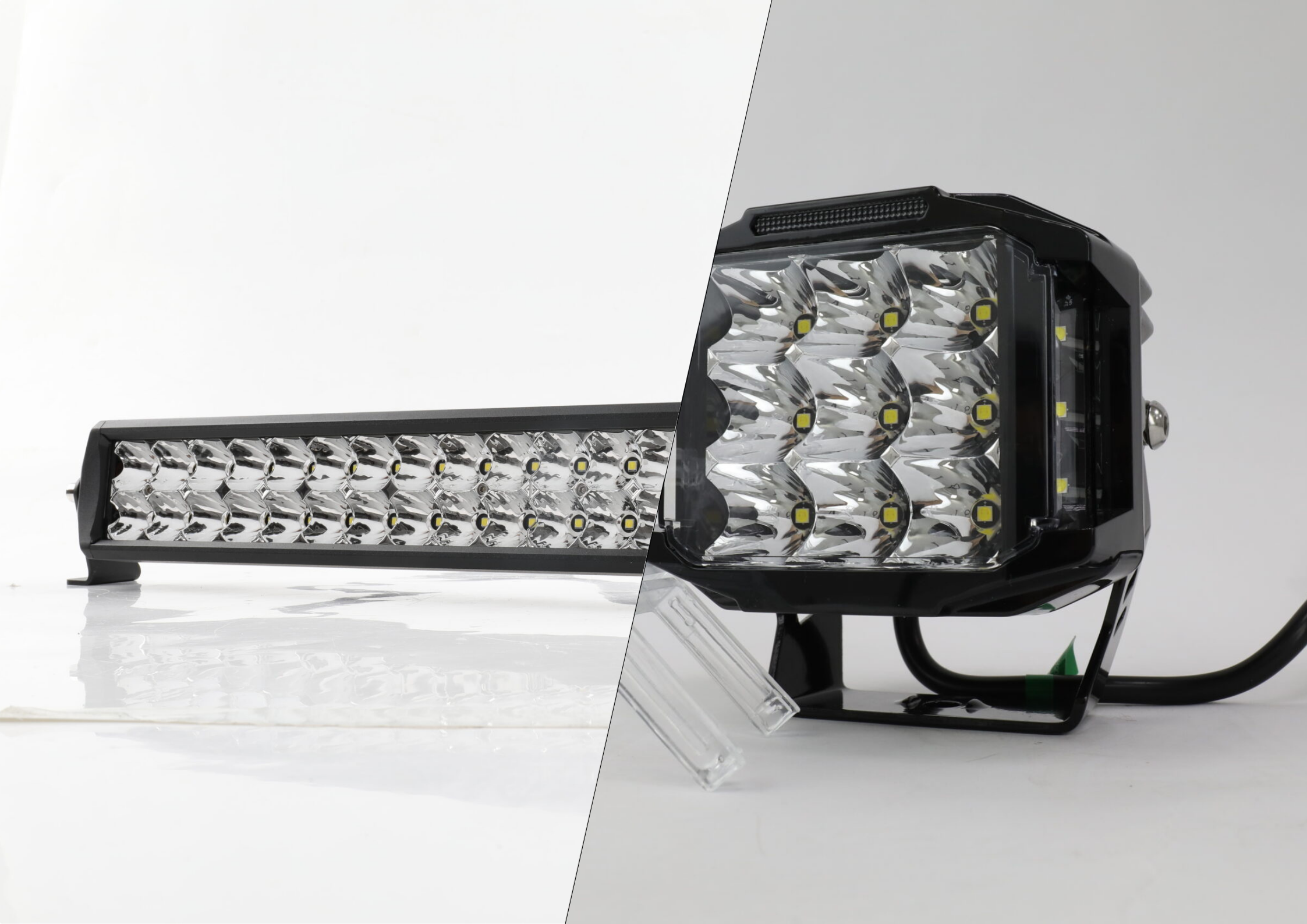
A LED bar (aka LED light bar or light bar) is an elongated light bar with several LEDs in a row. Whereas spotlights focus on a single narrow beam, an LED bar typically combines flood and spot LEDs in one housing. This provides a wide illuminated area both up close and at a distance, making it ideally suited as primary driving lighting in dark terrain.
Led bars are available in lengths from a few centimetres to over a metre and are mounted on the front bumper, roof rack or above the windscreen. Due to their horizontal design, they illuminate the area wide, an advantage over spotlights, which concentrate light more in the centre.
The light output of an LED bar ranges from 10,000 to more than 50,000 lumens, depending on the length and number of LEDs. Want to know more about choosing between an LED bar and an LED work light? Then read our extensive comparison of led bars and work lamps.
What is work lighting?
Under work lighting (also referred to as LED work light or work light led) include compact lamps that provide directional light to a specific area around the vehicle. They are not intended as driving lights, but as functional lighting when working, recovering or illuminating a camp or work area.
Work lights are available as flood (wide, close) or spot (narrow, far) and are often mounted on adjustable brackets so you can aim them exactly where light is needed. Think of lighting when mounting a winch, inspecting undercarriage in the dark or illuminating a workstation in the field.
They are compact, lightweight and easy to mount in almost any location: on the back of the cargo box, on the side of the vehicle, on a bumper rack or on a roof rack. On expedition vehicles, work lights are also used as camping lights around the vehicle.
What are the main differences?
The biggest difference is in the beam and purpose of use. Headlamps deliver a narrow, powerful beam at long range, ideal as a driving light at high speed. An LED bar illuminates wide and far at the same time, making it suitable as primary driving lighting in low-speed off-road terrain. Working lights focus on the immediate surroundings and are intended for functional use, not driving.
In terms of mounting, spotlights are the most compact and discreet. Led bars are more conspicuous and require a sturdy mounting location. Work lights are the most flexible due to their adjustable brackets and small size.
In terms of power consumption, all three types in LED versions are economical in relation to their light output. An LED bar does consume more power than a single spotlight or worklight due to its larger surface area, but this also makes it the most powerful option for driving lights.
Which combination suits your vehicle?
For most off-road drivers, a combination of multiple lighting types is the best approach. A classic setup for a 4×4 or SUV consists of an LED bar on the front bumper as primary driving lights, supplemented by a pair of spotlights for extra depth at long range and one or two work lights at the rear for recovery and camp situations.
Pickup drivers often opt for front-mounted spotlights or an LED bar, combined with work lights on the cargo box for on-site use. Expedition and overland vehicles benefit most from a roof rack-mounted LED bar as driving lights, spotlights on the front bumper and work lights scattered around the vehicle for a complete lighting setup.
Want to know which set-up best suits your vehicle and use? Take a look at our blog about led bars and work lights for offroad for more detailed explanations by vehicle type.
View our range of off-road lighting
Whether you are looking for compact spotlights for your 4×4, a wide LED bar for your roof rack or practical work lights for your pickup, at Lensen Products you will find a wide range of quality off-road lighting for every vehicle and application.
View our full range of off-road lighting and put together the lighting setup that suits your situation.
Not sure which combination will work best for your vehicle? Contact us for free advice - our specialists are happy to think with you.
Related articles: LED bar or LED work light: which do you choose for off-road? | Choosing an electric winch for your 4×4 | 12V systems and cabling
Frequently asked questions
An atomiser delivers a narrow, powerful beam at long distances, ideal as a supplement at high driving speeds. An LED bar illuminates wide and far at the same time via a combination of flood and spot LEDs, and is more suitable as primary driving lighting on low-speed off-road terrain.
Work lights are not intended for driving, but for functional use around the vehicle: in recovery, on-site maintenance or as camp lighting. They are more compact, adjustable and targeted to a specific work area.
A classic setup consists of an LED bar on the front bumper as driving lights, complemented by a pair of spotlights for extra depth at long range and one or two work lights at the rear for recovery and camp. That way you cover all situations.
Yes, LED spotlights deliver significantly higher light output at lower power consumption and last much longer than halogen. As a result, LED spotlights are now the standard choice for off-road applications.