

An electric winch can make the difference between an exciting off-road adventure and a dangerous situation. Whether you regularly drive through mud, take 4×4 trips through the countryside, or use your vehicle for heavy off-road work: a good winch gives you the security to pull yourself (or others) out of the most difficult situations.
But how do you choose the right electric winch for your 4×4? In this article, we explain what to look out for: from pulling power and voltage to cable selection and essential accessories.
Towing force: the most important specification when buying a winch
The pulling power of an electric winch is expressed in kilograms (kg) or pounds (lbs) and indicates the maximum weight the winch can pull. As a rule of thumb, choose a winch with a pulling force of at least 1.5 times the total weight of your vehicle.
If your 4×4 weighs 2,500 kg, for example, you will need at least a winch with a towing capacity of 3,750 kg (approx. 8,000 lbs). Also take into account extra ballast due to mud, water or heavy cargo, this increases the effective weight considerably.
Do you have a heavier pickup or a large SUV? Then look for winches with a capacity of 10,000 to 12,000 lbs. For lighter 4×4s or UTVs, models from 4,500 lbs are often sufficient.
12V winch or yet another connection?
Most electric winches for 4×4 use are designed for 12V systems, which fits the standard electrical system of almost any vehicle. Yet there are also 24V winches on the market. What are the differences?
12V winch: the most common choice
A 12V winch connects directly to your vehicle's battery and is plug-and-play to install on most 4×4s, jeeps and pickups. They are widely available, easy to maintain and suitable for recreational and semi-professional use. The vast majority of winches in our range operate on 12V.
24V winch: for heavier applications
A 24V winch delivers more power with less power consumption, making them suitable for heavy trucks, trucks or vehicles with 24V on-board power. They tend to be more powerful, but less universally applicable to standard 4×4s.
Battery and power supply: don't forget this
An electric winch pulls at maximum load 200 to 500 amps to power. Therefore, always make sure you have a powerful battery and consider a dual battery system for heavy use. Thin wiring is a common mistake that can lead to overheating or damage. Read more about proper battery use in our blog on 4×4 electrical systems.
Steel rope or synthetic rope: which do you choose?
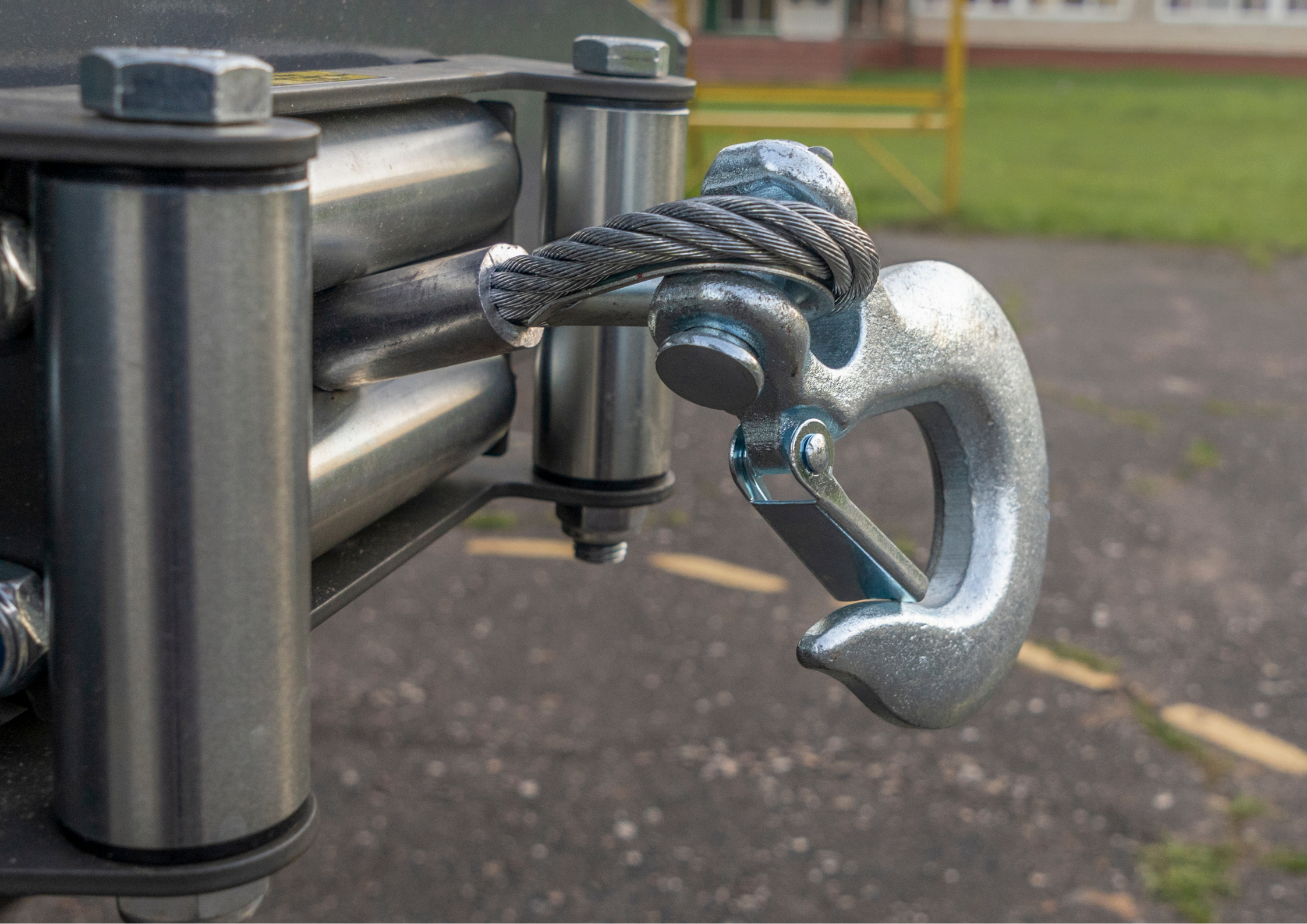
When choosing an electric winch, the choice of cable is at least as important as the motor itself. There are two options: the classic steel cable and the more modern synthetic winch rope.
Steel cable is robust, heat-resistant and relatively inexpensive. The downside: when broken, a steel cable can recoil like a whip and cause serious injury. In addition, steel rusts and can be more difficult to handle in wet weather.
Synthetic rope (such as Dyneema) is lighter, safer at breakage and easier to handle. When a rope breaks, it falls down instead of recoiling. It is ideal for recreational off-road use, but slightly more susceptible to abrasion from sharp edges.
For everyday off-road use and for beginners, we recommend synthetic rope. Professionals and people driving in extreme terrain often deliberately choose steel. Check out our full range of winch cables and ropes for the right choice.
Snatch block: double your pulling power
A snatch block is one of the most valuable accessories for your winch. This single pulley block gives you the ability to reroute the cable as well as double the pulling power of your winch - with no extra load on the motor.
Suppose your winch has a tensile force of 8,000 lbs. With a snatch block and a double cable run, you are effectively pulling at 16,000 lbs. This is particularly useful if you are stuck in tough terrain and need more power than the winch normally delivers.
Moreover, a snatch block allows you to use the adjust pulling angle, so you can winch even when there is no anchor point directly in front of your vehicle. An absolute must-have for serious off-road use. Check out our explanation of snatch blocks and winch accessories for more information.
Indispensable accessories with your electric winch
An electric winch is only complete with the right accessories. These are the basic parts you always want to have with you:
- Snatch block - for more traction and better angle options
- Tree saver strap - protects trees as an anchor point when winching
- D-shackles - for secure connections between rope, block and vehicle
- Winch gloves - protect your hands when working with wire rope
- Recovery strap - to connect another vehicle as an anchor point
- Roller fairlead (for steel ropes) or aluminium hawse fairlead (for synthetic rope)
Want to know which accessories best suit your situation? Read our complete guide to off-road recovery accessories or contact us for personal advice.
Ready to choose the right electric winch?
Whether you are looking for a compact 12V winch for an SUV, or a heavy-duty electric winch for your expedition truck, at Lensen Products you will find a wide range of reliable winches and related accessories.
View our full winch range and find the winch that suits your 4×4 and use.
In doubt or have a specific question? Contact us for free advice - our specialists will be happy to help.
Frequently asked questions
As a rule of thumb, choose a winch with a towing capacity of at least 1.5 times the total weight of your vehicle. If your 4×4 weighs 2,500 kg, you will need at least a winch of around 3,750 kg (±8,000 lbs). When in doubt, always choose a size bigger.
Steel rope is robust and heat-resistant, but dangerous if broken and prone to rust. Synthetic rope (such as Dyneema) is lighter, safer and easier to handle. For recreational off-road use, synthetic rope is the recommended choice.
A winch draws 200 to 500 amps at maximum load, more than a starter motor. For occasional use, a powerful standard battery is sufficient provided the engine is running. For intensive use, a dual battery system is highly recommended.
A snatch block is a pulley block that allows you to double the effective pull of your winch without putting more strain on the motor. With a winch of 8,000 lbs and a snatch block, you effectively pull 16,000 lbs. It also allows you to adjust the pulling angle.